Set latency and cost targets. Rivvr runs and continuously optimizes your inference to meet them, inside your AWS account.
Up to 70% lower inference cost
Cold starts under 30s
SLOs hold at 10× traffic bursts
Built by engineers from:


How is this different from SageMaker?
SageMaker gives you infrastructure and autoscaling controls. Rivvr removes the need to operate them: set latency and cost targets, and Rivvr continuously runs the infrastructure for you.
How is this different from AIBrix or NVIDIA Dynamo?
AIBrix and Dynamo are infrastructure software your team deploys, configures and maintains. Rivvr is a managed platform inside your AWS account. Instead of configuring profiling, autoscaling and infrastructure parameters, you specify the outcome: SLO + cost target.
Isn't spot capacity risky for something with an SLO?
Spot capacity is interruptible. Rivvr spreads workloads across compatible GPU capacity pools and uses on-demand as fallback, allowing capacity to change without sacrificing the SLO.
What data leaves my AWS account?
Inside your AWS account, behind your VPC. Inference traffic, data, and model weights never leave your environment.
How is Rivvr priced?
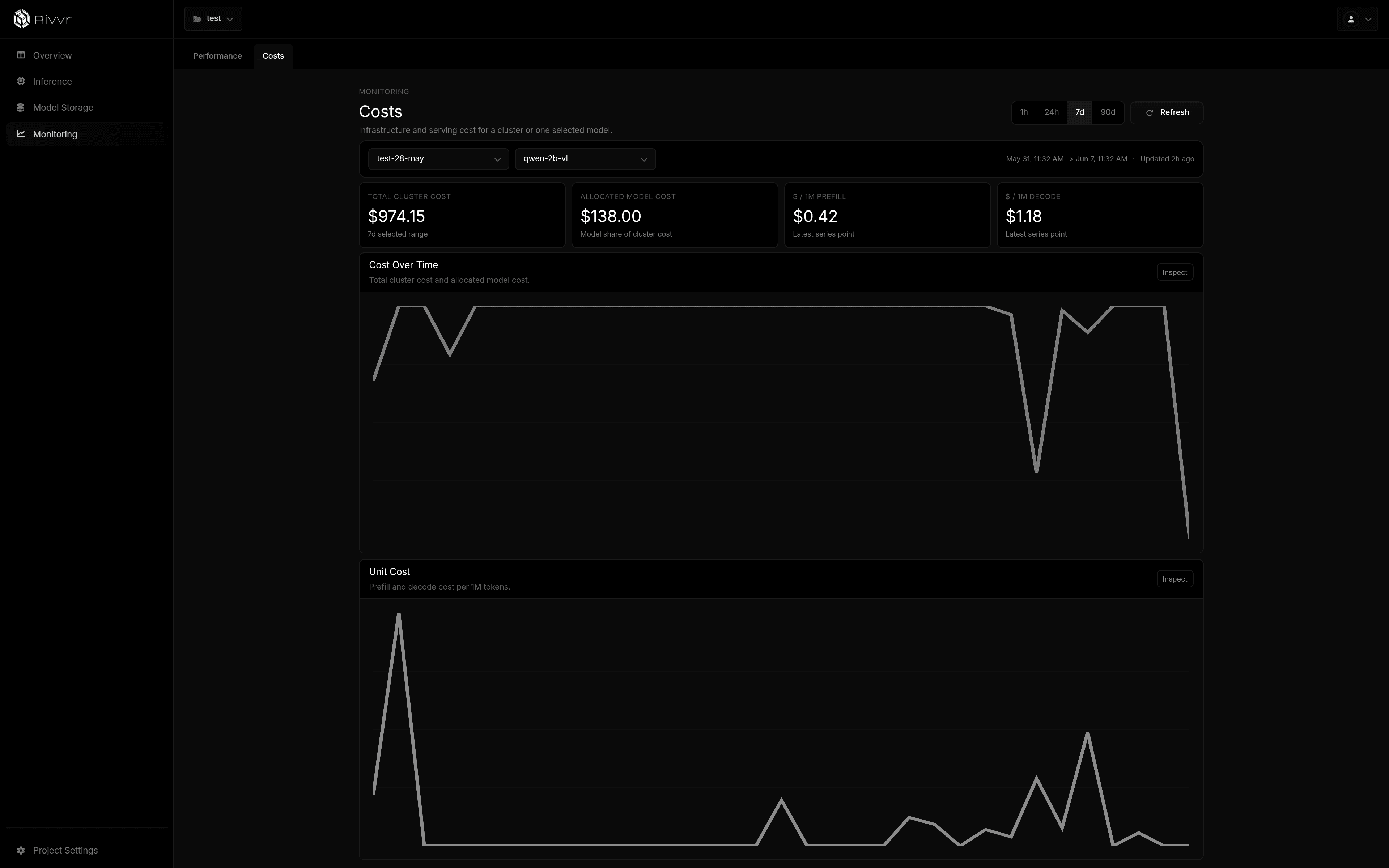
You pay AWS directly for infrastructure. Rivvr charges a separate management fee based on GPUs under orchestration.
Do I need to change my application?
Usually not. Rivvr exposes an OpenAI-compatible API, so most teams only change the endpoint.
Does Rivvr modify my model?
No. Model weights remain unchanged. Rivvr optimizes orchestration, placement and infrastructure.
What models are supported?
Any LLM supported by vLLM, currently up to 400B parameters.
What GPUs are supported?
NVIDIA CUDA compute capability 7.0+, including L4, L40S, A10G, T4, A100, H100, H200, B200, B300 and V100.